

TL;DR
New sales managers often fall into a trap: they try to prove they are smart instead of making their sellers better.
Here’s the truth:
- Feedback is not coaching.
- Toughness without clarity is ego.
- Call reviews should build seller judgment, not manager status.
- Great coaching isolates the moment, explains the impact, gives the seller language, and creates a repeatable move.
- The best sales leaders do not perform authority. They transfer capability.
The Real Problem: Sales Feedback Often Becomes Sales Leader Theater
Have you ever watched a new sales manager run a call review like they were auditioning for the VP role?
They challenge everything.
They talk over the rep.
They explain what they would have done.
They sound smart.
And somehow, the seller leaves less clear than when the meeting started.
That is not coaching.
That is sales leader theater.
The Pressure New Sales Managers Feel
New sales managers are not usually trying to hurt their teams.
Most are trying to survive.
They were promoted because they could sell. Now they are expected to forecast, coach, inspect pipeline, motivate the team, handle executive pressure, and still jump in when a deal starts smoking.
That is a lot.
The problem is they often reach for the wrong tool.
They try to prove competence instead of building it.
They find themselves in anew world. Most managers face extreme downward pressure in a highly competitive environment where the business lives and dies by the bottom line.
They Want to Prove They Earned the Role
New sales managers are often under more pressure than they admit.
They want to prove they earned the role. They want senior leaders to see they can command the room. They want the team to know they are strategic, decisive, and not afraid to challenge weak thinking.
A lot of new sales managers are not intentionally trying to be ineffective. They are trying to be credible. They are trying to show they have earned the seat. They are trying to demonstrate strategic thinking, executive presence, and command of the business.
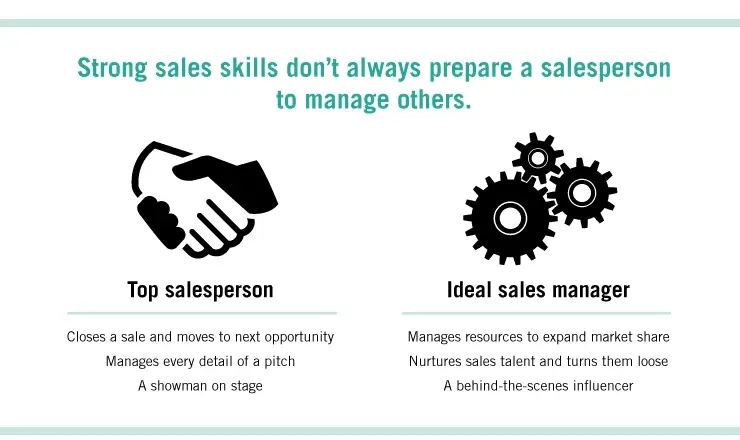
However, many of these new sales managers receive absolutely zero formal management training. Without the proper tools to lead, they often fall back on what made them successful in the first place, suffering from “super salesperson syndrome”. They struggle to disconnect from the thrill of selling and fail to make the crucial transition from taking care of themselves to taking care of others.
When Insecurity Wears a Manager Title
But too often, that pressure turns into sales leader theater.
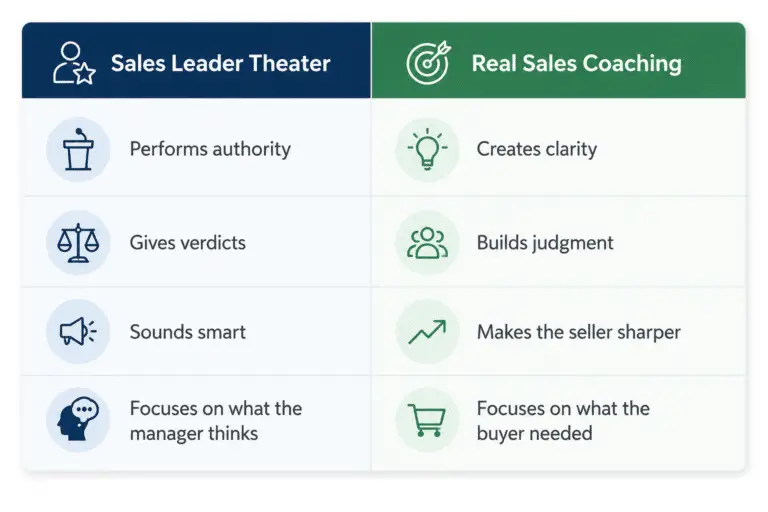
The manager performs authority instead of creating clarity. They critique instead of coach. They tell the rep what they would have done, but never teach the rep how to think better next time.
That is not leadership. That is insecurity wearing a manager title.
The manager critiques.
The seller defends.
The deal does not improve.
That is the cost.
Because elite salespeople often operate on instinct, they lack the “conscious competence” required to explain why a tactic works or diagnose where a rep’s process broke down.
Unable to effectively coach these specific behaviors, they default to jumping in and “saving” deals, creating dependency instead of capability.
When leaders feel out of their depth, they mask their insecurity under fake authority, pretending to have all the answers to appear in control. Instead of empowering their reps, they micromanage details while failing to provide actual strategic direction.
When that insecurity shows up as critique, sarcasm, or control, it does not look like leadership.
It looks like theater.
Feedback Should Make the Seller Sharper, Not the Manager Louder
Every sales leader has listened to a call and thought, “I would have handled that differently.”
Fine.
But that thought is not coaching.
The goal of call review is not to prove the manager saw the play faster. The goal is to help the seller see the field better next time.
The Central Failure of Most Feedback
Most sales feedback fails because it tells the seller what the manager thinks instead of helping the seller understand what the buyer needed.
That is the difference between opinion and development.
Opinion says, “Here is what I think.”
Development says, “Here is what the buyer showed us, here is why it mattered, and here is the move to make next time.”
Feedback Is Not About Proving the Manager Was Right
The root cause of this problem is that managers are conditioned to believe that their value comes from having all the answers. Throughout their careers, they were promoted and praised for delivering advice and solving problems.
Michael Bungay Stanier, author of The Coaching Habit, trained myself and other sales leaders at Microsoft. He shared that when managers step into leadership, they often fall victim to the “Advice Monster” – the overwhelming urge to leap in, offer solutions, and stay in control of the situation.
It’s a perfect description for a common issue. Feedback should not prove the manager’s intelligence. It should improve the seller’s judgment.
For many managers, asserting their expertise and giving advice feels far more comfortable than sitting in the ambiguity of asking questions, even if the advice they are giving is wrong.
Michael’s feedback still echo’s in my head: “stay curious longer”. It’s a refrain that is such a valuable guide to coaching.
The Problem: Authoritative Feedback Breeds Defensiveness
When a manager uses feedback to prove they are right, they stop guiding and start judging. Research from the Center for Creative Leadership emphasizes that feedback is supposed to be about addressing specific actions, not “fixing” employees. When managers deliver feedback by leveraging their positional power, acting commanding, arrogant, or self-centered, the message is completely lost. Judging individuals sends the underlying message that only the manager knows what is right or wrong, which immediately forces the employee into a defensive or argumentative posture.
The Real-World Symptom: The Call Review Trap
Every sales leader has listened to a call and thought, “I would have handled that differently.”
But the goal of call review is not to prove the manager is smarter. The goal is to make the seller sharper.
When the goal of feedback is for the manager to prove their superiority, conversations turn into condescending lectures. In discussions among real sales professionals, a common complaint is the manager who treats highly experienced reps like “students” to be lectured, or who operates under the delusion that their knowledge is absolute. When a manager simply solves the problem to prove they can, the rep never learns how to think independently.
The Solution: Shift from “Performance” to “Development”
To break this cycle, leaders must shift from coaching for performance (putting out the immediate fire or fixing a specific issue) to coaching for development (focusing on the person trying to manage the fire). This requires the manager to surrender the need to be the “expert.” Good coaching means acting slower, staying curious longer, and asking questions that allow the rep to generate their own insights, rather than just telling them what you would have done.
What Sales Leader Theater Sounds Like
Sales leader theater usually sounds confident.
That is what makes it dangerous.
It sounds like:
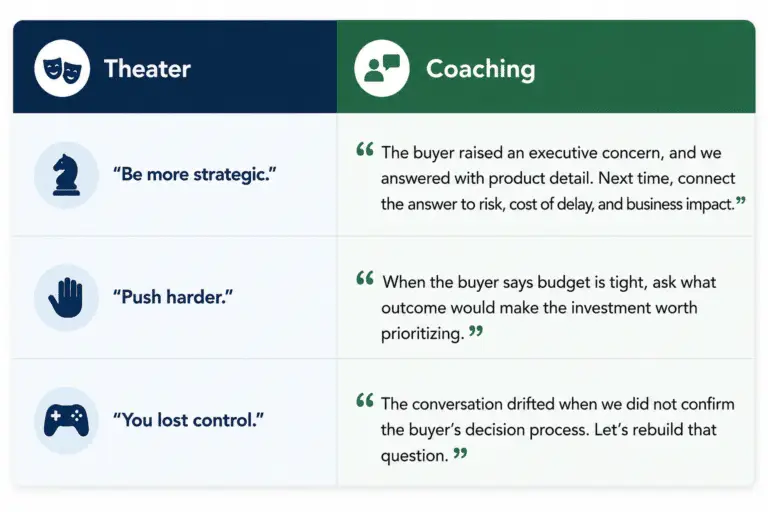
- “You should have pushed harder.”
- “That was not strategic enough.”
- “I would not have led with that.”
- “You need to show up bigger.”
- “You need to create more urgency.”
- “Here is what I would have done.”
Look, some of those statements may even be true.
But truth without usefulness is still lazy coaching.
Fake Questions and Interrogations
Some managers hide their advice inside fake questions.
“Did you think about asking procurement earlier?”
“Have you considered going higher?”
“Why didn’t you challenge that?”
Those are not questions.
Those are verdicts wearing a question mark.
Hiding Behind the Digital Shield of Email
And please, do not hide behind email. It’s easy to say harsh things that you would never say in person. It’s called the “Online Disinhibition Effect”.
If the feedback is emotional, nuanced, or likely to be misread, pick up the phone or get face to face.
A sarcastic email may make you feel powerful for ten seconds.
It can cost you trust for ten months.

Why These Comments Fail
The problem is that none of those statements actually develop the seller.
They may make the manager feel sharper, but they leave the rep with fog, not clarity.
Fog statements:
- Push harder
- Be more strategic
- Show up bigger
Clarity statements:
- Here is the missed buyer signal
- Here is why the positioning weakened
- Here is the stronger question
- Here is what to practice next
What Real Coaching Sounds Like
Real coaching sounds different.
It is calmer.
It is more specific.
It does not try to win the conversation.
It tries to improve the next one.
Coaching Converts Feedback Into Seller Capability
Real coaching is not about the manager jumping in to fix a problem or prove their expertise; it is about building the seller’s independent critical thinking. When managers simply solve problems instead of coaching, reps never learn to think independently.
Specific Coaching Language
Real coaching is more specific:
- “Here is the moment where the conversation narrowed.”
- “Here is why leading with a small test may have lowered our perceived value.”
- “Here is the buyer goal I heard.”
- “Here is the stronger executive-level question to ask next time.”
- “Let’s rebuild the next call plan together.”
- “Try this language and let’s practice it before the follow-up.”
Real coaching does not start with a verdict.
It starts with impact.
Don’t tell the seller, “You were too soft,” or “You should have pushed harder.”
That does not help them.
It just puts them on defense.
Instead, show them what happened in the deal.
Say:
“When the buyer asked about implementation risk, we answered with product details. That kept the conversation tactical instead of executive-level. The stronger move would have been to connect the answer to timeline, adoption, cost of delay, and business confidence.”
See the difference?
Now you are not attacking the seller.
You are showing the seller the impact of the moment.
That is useful.
Great coaches do not hide behind vague words like “always,” “never,” “weak,” or “not strategic.” They get specific.
What happened?
What did the buyer hear?
How did it affect confidence, urgency, trust, or deal momentum?
What should we do differently next time?
That is the work.
And this is where new managers have to slow down. Many great sellers know how to win, but they cannot always explain why they win. That is the shift from seller to leader.
You have to break the play down.
Why did that question work?
Where did the conversation narrow?
What signal did the buyer give us?
What move should the seller repeat next time?
When you coach this way, the rep does not just receive orders.
They learn how to think.
And once they learn how to think, they can make better decisions when you are not in the room.
That is coaching.
The Shift That Matters
That is the shift from manager performance to seller development.
The best sales leaders do not perform authority. They transfer capability.
Watch for the urge to leap in, take over, and save the deal. Stop creating dependency and start building capability. Be patient instead of reactive, and curious instead of directive.
Five Rules for Better Sales Coaching
Here’s the truth most sales managers don’t want to admit:
Feedback is not coaching.
Telling a seller, “You need to ask better questions,” is not coaching.
Saying, “You should have pushed harder,” is not coaching.
Dropping a stream of random reactions after a call is not coaching either.
That’s just noise.
And noise does not build confidence.
It creates confusion.
If you want your sellers to grow, you have to coach with clarity, purpose, and discipline. You have to help them see the moment, understand the impact, practice the move, and build the judgment to do it without you standing over their shoulder.
Sound familiar?
Let’s get real.
Rule 1 — Play Freeze Tag: Isolate the Moment
Remember freeze tag?
Someone yelled “freeze,” and everyone stopped right where they were.
Sales coaching should work the same way.
You don’t need to replay the entire call like a sports commentator who drank too much coffee. You need to freeze the exact moment where something changed.
The buyer hesitated.
The seller missed a cue.
The executive gave a clue about business impact.
The conversation drifted into feature dumping.
The deal either gained momentum… or started sliding sideways.
That’s the moment you coach.
In digital sales, you can do this right after the call.
In field sales, I used what I called my 20-step rule. I would not get more than 20 steps outside the customer’s building before coaching the moment. Usually in the parking lot. Sometimes off to the side. Always privately.
Why?
Because time kills clarity.
The enemy of sales is time—and it’s the enemy of coaching too.

Coaching Move
Don’t say:
“You missed a lot in that meeting.”
Say:
“Let’s freeze the conversation at the moment the buyer said, ‘We’re not sure this is a priority right now.’ What did you hear? What did you think they meant? What could you have asked next?”
Coaching Question
“What was the moment where the buyer’s goal, concern, or expectation became clearer?”
That question forces reflection.
And reflection builds skill.
Visual idea:
A call timeline with one highlighted “freeze moment.”
Rule 2 — Explain the Business Impact
Here’s the thing.
Salespeople are a unique bunch.
Some are gifted presenters.
Some negotiate like they were born in a boardroom.
Some can run CRM with military precision.
Some sell in a style that looks completely different from yours—and still works.
Don’t coach style when the substance is working.
That’s where a lot of managers get sideways. They try to clone themselves. They force the rep into a “my way or the highway” process because it makes the manager feel in control.
Bad move.
A great coach does not bark commands.
A great coach connects behavior to business impact.
Because executive buyers do not care that your seller “sounded confident.”
They care about revenue.
Risk.
Margin.
Strategic priorities.
Speed.
ROI.
Consensus.
No decision.
If the seller’s behavior helped the buyer connect your solution to those outcomes, build on it. If it did not, coach the gap.
A seller does not become more strategic by being told to “be strategic.” They become more strategic when they learn how buyers connect action to impact.
Coaching Move
Don’t say:
“You need to talk more strategically.”
Say:
“When the VP asked about implementation risk, you answered with features. That kept the conversation at the product level. Next time, connect the answer to business impact: timeline risk, adoption risk, cost of delay, and executive confidence.”
Now the seller knows what changed.
They know why it mattered.
They know how to adjust.
That’s coaching.
Coaching Question
“How did that behavior affect the buyer’s confidence, risk perception, or urgency?”
Get them thinking beyond words.
Get them thinking about outcomes.
Rule 3— Use a Coaching Framework
Great coaching creates clarity.
Bad coaching creates fog.
And too many managers create fog because they react instead of structure.
They jump from one observation to another.
They coach tone, then pipeline, then next steps, then CRM hygiene, then forecast accuracy.
The seller walks away thinking, “What just happened?”
That’s not coaching.
That’s a drive-by.
Use a framework.
Keep it simple.
Every coaching moment should answer four questions:
- What happened?
- Why did it matter?
- What should change?
- How will we practice it?
I call this:
Moment. Meaning. Move. Motion.
Moment
What happened?
Freeze the exact point in the conversation.
Meaning
Why did it matter?
Connect the behavior to deal impact.
Move
What should change?
Give the seller a better question, phrase, or decision path.
Motion
How will we practice it?
Role-play it. Rewrite it. Rehearse it. Use AI if it helps. Practice until the seller owns it.
Because knowing is not the same as doing.
And doing once is not the same as building a habit.
Coaching Question
“What is the one move we need to practice before the next customer conversation?”
One move.
Not twelve.
Focus creates momentum.
Rule 4— Convert Criticism Into a Repeatable Move
Listen up.
Your seller does not need more vague criticism.
They need language.
They need a move.
They need something they can use the next time the buyer pushes back, stalls, ghosts, or throws a budget grenade into the room.
Telling a rep, “You should have pushed harder,” is lazy coaching.
No kidding.
What does “push harder” mean?
Talk louder?
Interrupt more?
Send three follow-up emails with “just checking in” in the subject line? Please don’t.
A seller should leave coaching knowing exactly what to say next time.
If the seller leaves without better language, you gave commentary—not coaching.
Coaching Move
Critique:
“You should have pushed harder.”
Repeatable move:
“When the buyer says budget is limited, ask: ‘What would make this test meaningful enough to influence your next investment decision?’”
See the difference?
One creates shame.
The other creates skill.
The same applies to messaging. If the rep says, “We help improve your marketing strategy,” that sounds generic because it is generic.
Coach them into buyer language.
Better:
“I noticed your team just launched a new product. If your goal is faster market awareness, here’s where we can help amplify the campaign and shorten the time to pipeline.”
Specific beats slick.
Clear beats clever.
Customer language beats corporate jargon every day of the week.
Coaching Question
“What exact words should the seller use the next time this situation happens?”
If you cannot answer that, you are not done coaching.
Rule 5 — Build Judgment, Not Compliance
This is the big one.
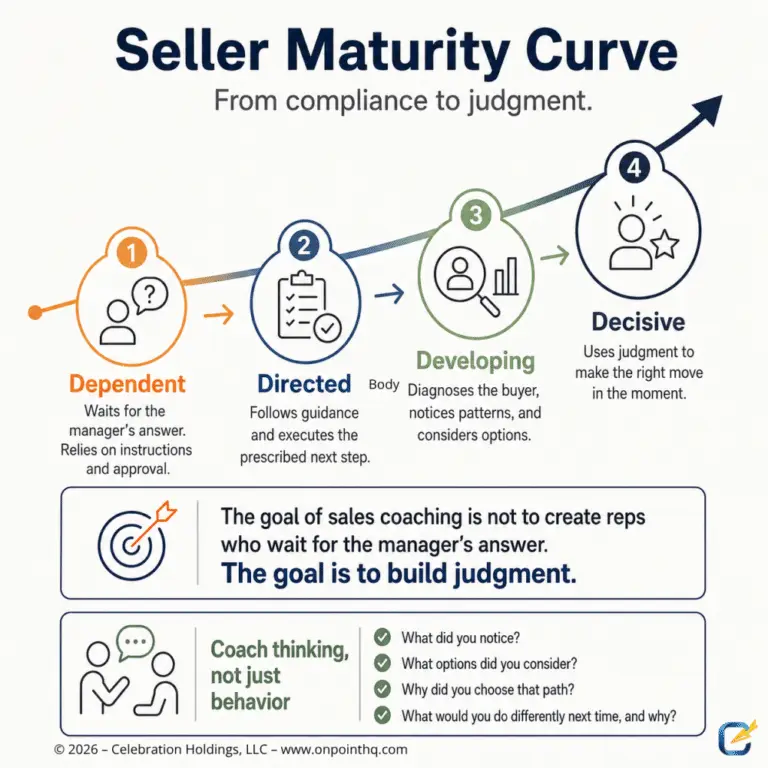
The goal of sales coaching is not to create reps who wait for the manager’s answer.
That’s compliance.
And compliance breaks down the second the seller is alone with a buyer.
The goal is to build judgment.
You want sellers who can diagnose the buyer, read the room, understand the business issue, and make the right move in the moment.
That takes confidence.
That takes practice.
That takes a leader willing to coach thinking, not just behavior.
If all you do is tell people what to do, they will keep coming back for instructions.
If you teach them how to think, they start making better decisions without you.
That’s when you know coaching is working.
Compliance may get you through the next call. Judgment changes the seller’s career.
Coaching Move
Don’t ask:
“Did you do what I told you?”
Ask:
“What did you notice? What options did you consider? Why did you choose that path?”
Now you are developing judgment.
You are building a seller who can operate under pressure.
You are helping them become more valuable, more confident, and more trusted by buyers.
That’s the magic of coaching done right.
Coaching Question
“What would you do differently next time, and why?”
The “why” matters.
That’s where judgment lives.
The AIM OnPoint™ Sales Coaching Lens
The five rules give managers a better way to coach.
AIM OnPoint™ gives them a better lens for what to coach.
Because every coaching conversation should help the manager and seller do three things:
Acquire the real signal.
Integrate it into the buyer’s logic.
Maximize the next move.
Acquire — Understand the Buyer’s Real Business Goal
Diagnose Before You Direct
Acquire: Understand the buyer’s real business goal.
Listen for the seller’s actual development gap. Was it discovery? Business acumen? Deal strategy? Executive confidence? Measurement knowledge?
Integrate — Connect the Recommendation to the Customer’s Buying Logic
Do Not Pitch Tactics in Isolation
Integrate: Connect the recommendation to the customer’s buying logic.
Do not just correct the seller. Help them understand how the customer thinks.
Maximize — Turn the Moment Into a Repeatable Improvement
Coaching Should Create the Next Better Move
Coach the seller into a repeatable improvement.
Not “you should have done better,” but “here is the stronger move for the next call.”
Give the seller language, practice, and a sharper next move.
The Test of Feedback: Did the Seller Improve?
Here is the test.
If the seller leaves confused, embarrassed, or defensive, the manager may have vented—but they did not coach.
If the seller leaves with clearer thinking, better language, and a stronger next step, coaching happened.
That is the standard.
Feedback should produce clarity, confidence, and better execution. If it does not, check your approach.
This Is Not About Being Nicer
Do not misunderstand me.
This is not an argument for soft leadership.
High standards matter.
Tough feedback matters.
Sellers need to be challenged.
But challenge without clarity is just ego.
The standard is not niceness.
The standard is usefulness.
Sales Leaders Should Develop Decision-Makers
The best sales managers do not just review calls.
They develop decision-makers.
Sales leadership is not a stage for proving competence. It is a responsibility to build competence in others.
So before your next call review, ask yourself one question:
Will this feedback make me sound smart, or will it make my seller sharper?
If the answer is only the first one, stop.
Freeze the moment.
Explain the impact.
Give them the move.
Practice it.
Build judgment.
That is coaching.
What are you waiting for?