

(And why most leaders won’t realize it until revenue stalls)
New data from the Celebration OnPoint AI Visibility Index™ shows how authority—not traffic—is driving revenue outcomes across industries.
Intro to the AI Search Traffic Decline
Let me cut straight to it: if your search visibility has been sliding since mid-2024 and you’ve been wondering whether something’s broken on your end—it's not.
You're living through a structural shift in how search works. This is a new era in search, driven by generative AI and large language models, fundamentally changing how users interact with information online.
For the last 20 years, revenue leaders built growth on a simple assumption:
If we rank, we win.
That assumption is now broken.
AI sits between the buyer and the web. It answers first. It cites selectively. And in a growing number of cases, it never sends the click.
Generative systems—Google AI Overviews, ChatGPT, Perplexity, Copilot—are training users to get what they want without visiting your site. AI companies are driving the development and deployment of these disruptive technologies, reshaping the digital landscape and forcing publishers to reconsider their strategies and revenue models.
AI search engines are transforming traditional search by providing direct, AI-generated answers within the search results page, often eliminating the need for users to click through to other websites.
Bain reports that as much as 80% of searches can end without a website visit. Your content can be used… without your brand being chosen. The majority of searches featuring AI Overviews have informational intent, and AI Overviews can cause a decline in organic traffic ranging from 15% to 64%, depending on the industry and search type.
That’s not a temporary trend. That’s a permanent shift in how visibility works.
This isn't a “work harder” post.
This is a control vs. dependency moment.
And if your revenue pipeline depends on being found… your survival depends on adapting.
This isn't a feel-good article about “getting after it in the new year.”
This is a wake-up call.
Because AI search isn't killing traffic.
It's killing fragile business models that depended on borrowed attention.
Now ask yourself: how dependent is your pipeline on being discovered by someone else's platform?
If your business relies on trust, transparency, accessibility, or public confidence… this isn't a marketing issue.
It's a revenue issue.
The Great Reset: Why Leaders Must Adapt Revenue Strategies in 2026
If your growth strategy still depends on clicks, you're already behind.
For years, revenue strategy assumed one thing was stable: distribution. If you invested enough in SEO, content, and paid acquisition, demand would eventually flow back to you.
That assumption no longer holds.
AI didn't just change how answers are delivered. It changed who controls demand.
Search used to be a referral engine. Now it's an recommendation layer.
And when AI arbitrates answers, it doesn't care how much content you published, how hard you worked for rankings, or how long you've played the game. It selects what it believes is safe, authoritative, and sufficient—and omits the rest.
That's the reset.
This isn't about visibility tactics. It's about who owns the relationship with the buyer at the moment of decision. Traditional engine optimization is evolving as AI-driven search changes the landscape, and answer engine optimization (AEO) is emerging as a new approach to help brands adapt to answer engines and AI-powered search interfaces.
For two decades, leaders invested millions building traffic they never truly owned.AI didn't break that model. It revealed it.
AI search isn't killing traffic. It's killing fragile revenue models built on borrowed attention.
And the more your pipeline depends on being “found,” the more exposed you already are.
Marketers need to refine their SEO efforts while also experimenting with new strategies to adapt to AI-driven search, such as implementing Generative Engine Optimization (GEO) or Answer Engine Optimization (AEO) techniques.
From Results to Responses
I'm old enough to remember relics of the past, like the yellow pages. Companies would name themselves AAA Plumbing just so they would be found at the beginning of the directory.
Then internet search came along, which Google has dominated. It catalogued websites and offered preferred placement to those who paid to play.
Today's search is no longer a directory. It's an answer engine.
AI doesn't send users to you. Even if you pay for it. It summarizes you.
And most brands today never make the summary. With the rise of AI Overviews, organic search results are being pushed further down the page—sometimes by as much as 1,500 pixels—displacing even top-ranked links and significantly lowering click-through rates.
Here's an example of a recent Google AI Overview summarizing the state of the CRM market. The market is one that has thousands of companies vying for attention. G2, a popular software marketplace, has 895 listings for CRM.
Google summarized this market to six. For the thousands of other SaaS based CRM companies, this should keep you up at night.

The Zero-Click Crisis: Understanding the New Search Reality
In fact, many users are never clicking on the links they discover in search engines. Once an answer is revealed, the user goes straight to the source. This results in what is called a “zero-click search”.
Forbes defines zero click when the user finds what they'e looking for without having to click a link from the search engine results page. The click through rate for both organic and paid listings has dropped significantly, with studies showing that about 60% of searches now yield no clicks at all due to AI-generated answers being provided directly on the search results page.
Here's the zero-click behavior in practice:
- User types a question
- AI summary appears immediately at the top of the search page
- User reads the ai generated summary
- Maybe they glance at brand logos or favicons
- They never hit your page
You’ve no doubt seen these in today's generative AI systems—Google AI Overviews, the Search Generative Experience, ChatGPT, Perplexity, Copilot—all now answer queries directly on the search page or in chat. Users get what they came for without clicking anything. They show up as
- Featured answers
- AI overviews
- Conversational responses
When AI Overviews are present, click throughs to websites drop dramatically, with only about 1% of users clicking the links cited in AIO results.
Your content gets used… but your brand never gets visited.
The Staggering Scale of the Disruption
This isn't a single algorithm update you can wait out or reverse-engineer.
What's happening now is the compound effect of two forces moving at once:
- AI systems fundamentally changing how answers are generated and surfaced
- User behavior adapting faster than most organizations realize
This shift is leading to a significant decrease in search traffic for many industries, as AI-driven summaries and generative search engines reduce traditional organic search traffic and click-through rates.
That shift began in earnest in 2024, and it's accelerating—not stabilizing. Which means this isn't something marketing can “fix” in isolation. It touches every customer-facing function: marketing, sales, partnerships, support, and even product strategy.
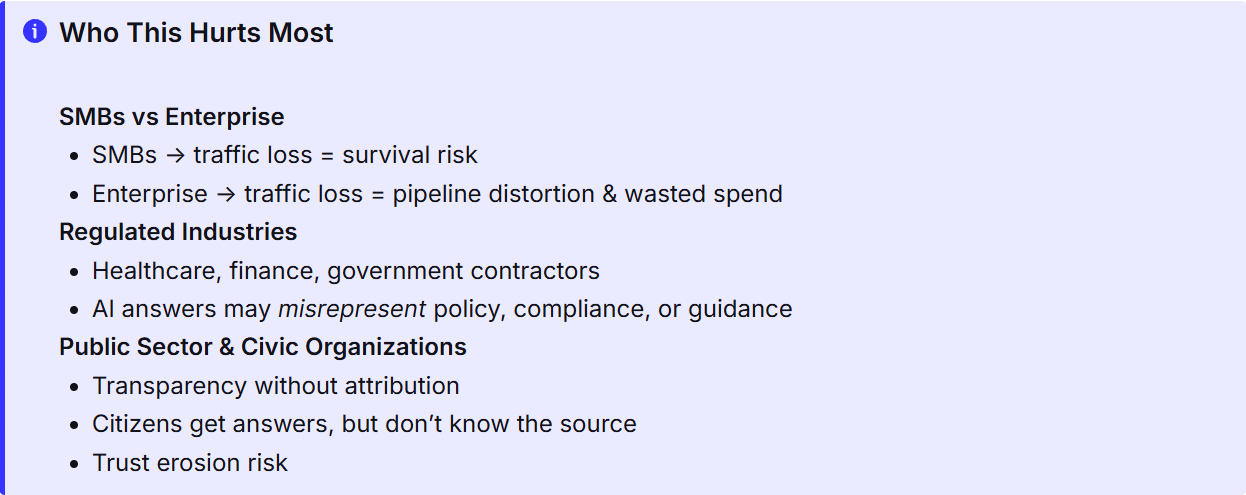
What makes this moment especially dangerous is that the impact isn't uniform. Some industries are losing visibility quickly. Others are holding steady—or even gaining. The surface-level narrative (“AI is killing traffic”) doesn't explain what's actually happening underneath.
That's why we built the OnPoint AI Visibility Index™.
This is an ongoing, quarterly research initiative designed to measure how AI search is reshaping discoverability across industries, business models, and authority profiles. We use SEMrush organic traffic estimates alongside other data sources to isolate structural change, not seasonal noise.
Industry data from Elementor suggests AI-driven discovery will surpass traditional search by 2028. The decline in organic traffic is prompting marketers to reconsider their digital visibility strategies, as users are shifting from keyword-based searches to single, complex conversations with AI chatbots that synthesize information. The question isn't if visibility shifts—it's who benefits, who gets displaced, and why.
At the highest level, the data confirms what many leaders are already sensing: AI is changing how visibility is allocated. But once you break it down by industry, the story becomes far more nuanced—and far more actionable.
Let's look at what's really happening.
The Mobile-First Zero-Click Future
On mobile, the answer is the destination. Mobile search has been dominating internet traffic for the last five years, and the zero-click paradigm will only get bigger. Mobile users demand instant answers with minimal friction. This is what made the Apple Appstore grow astronomically, and it's precisely what AI-powered search delivers. The rise of zero click searches means that roughly 60% of searches now yield no clicks at all, as AI-generated answers satisfy users directly on the search results page. About 80% of consumers now rely on zero-click results in at least 40% of their searches, reducing organic web traffic by an estimated 15% to 25%.
⚠️Reality check: If your value only exists after the click, you don't have leverage anymore.
✅Action: Start designing content that stands alone, not content that hopes to be clicked. If you are not optimizing content for mobile devices, you're already at a disadvantage. This means speed, and streamlined user experiences. If answers are buried where they are hard to find, you need to change immediately.
The Business Casualties — And Why You Need a Plan
Organizations Are in a Visibility Flat Spin
If you're leading a business today, you've felt it—even if you haven't fully named it yet.
Visibility is slipping. Pipeline pressure is building. And revenue conversations are getting tighter.
The pattern shows up the same way almost everywhere:
Traffic drops first. Pipeline stalls second. With anemic revenue, budget cuts follow.
This isn't because teams suddenly forgot how to market.
It's because the distribution layer changed.
Yes, AI tools like ChatGPT, Copilot, and Perplexity do send links. But the reality is sobering: the volume is a drizzle, not a river. Even as AI citations grow rapidly in percentage terms—Previsible.io tracked a 527% year-over-year increase from early 2024 to 2025—they still represent roughly 1% or less of total traffic for most publishers.
The platforms themselves are growing explosively. ChatGPT alone logged 5 billion visits in August 2025. Perplexity crossed 176 million, Claude 167 million. Those numbers are staggering.
But the referral traffic flowing out remains small—and volatile.
AI systems choose sources selectively. They overweight:
- Wikipedia
- Large tech media brands
- Reddit and community threads
- Major review platforms
News publishers and news websites have been particularly hard hit by this shift. Some publishers have reported losing 20%, 30%, and in some cases even as much as 90% of their traffic and revenue over the past year due to AI search.
For many mid-tier organizations, even high-quality content doesn't translate into consistent AI visibility. One model update or prompt tweak can redirect citations overnight. One week you're referenced. The next week, you’re gone.
That volatility is what's putting organizations into a flat spin.
Layoffs, Budget Cuts, and Business Model Stress
This is where the consequences compound.
AI isn't “replacing jobs.” It's replacing work that can be summarized without judgment. For example, recipe blogs—niche publishers—have seen significant traffic declines as AI-driven search features and summaries reduce the need for users to visit their sites.
And when discovery weakens, SEO dependency becomes an operational risk, not a marketing tactic.
Marketing didn't fail. Your agency didn't fail. Your tools didn't fail.
The assumption failed.
The assumption that effort guaranteed visibility. The assumption that rankings meant reach. The assumption that traffic equaled control.
Why Some Hurt More Than Others (The AI Visibility Index™)
Here's the critical insight most conversations miss:
AI search is not reducing visibility evenly. It is redistributing attention based on authority, intent, and replaceability.
That's why anecdotal stories are misleading.
To understand what's actually happening, we analyzed 60 organizations across five distinct sectors, classifying them by:
- Company size (Enterprise, SMB, Gov/Public Sector)
- Business model (27 distinct revenue models)
- Authority model (institutional, brand, destination, or commodity)
The goal wasn't to predict revenue. It was to isolate discoverability risk in an AI-mediated search environment.
This is the foundation of the OnPoint AI Visibility Index™, which we'll continue to expand quarterly as AI search evolves.
Once you look at the data this way, a very different story emerges.
When we broke the data down by industry, a clear pattern emerged.
AI search is not reducing visibility evenly. It is redistributing attention—and the winners and losers are not where most leaders expect.
Across five major sectors, we found that:
- Digital publishers are the first clear losers, showing measurable visibility decline as AI answers replace top-of-funnel content. Most of their traffic comes from informational queries and informational searches, which are heavily impacted by AI Overviews.
- B2B technology companies are in a temporary advantage window, benefiting from brand gravity and product-led intent.
- Healthcare and public sector organizations remain structurally protected due to institutional authority and trust requirements.
- Tribal casino and resort brands are unexpectedly outperforming, as AI behaves more like a concierge than a substitute in destination-driven search for this market right now.
For example, Chegg is suing Google due to massive losses in traffic and revenue since the launch of AI Overviews, as 86% of its ranked keywords have informational intent.
The takeaway is simple but uncomfortable:
AI doesn't kill traffic. It eliminates traffic that can be abstracted into answers.
What survives—and even grows—are brands that AI must defer to, not summarize away.
To understand why these outcomes differ so sharply, it's important to understand how to read the charts that follow.
How to Read These Charts
Each chart compares average monthly organic visibility before and after July 2024, which we use as a practical proxy for the broad rollout of AI-generated answers across major search experiences.
- Pre-AI represents baseline visibility before large-scale AI answers were widely deployed.
- Post-AI reflects visibility after AI-mediated search became common.
- Percentage change highlights structural shift, not seasonal fluctuation.
These charts do not predict revenue.
They measure discoverability risk and advantage in an AI-mediated search environment.
Industry Findings & Narratives
1. Digital Publishers: The Canary in the Coal Mine
Key Finding: Digital publishers are the only sector showing consistent net decline in organic visibility post-AI.
What the chart shows: Most publishers experienced double-digit negative shifts, with only a few brand-anchored outliers (e.g., NYT) holding ground. Even strong brands like the New York Times show volatility, including declines in paid visibility—underscoring that scale alone is not protection.
Why this is happening:
- Heavy reliance on informational content
- Content that AI can summarize without attribution
- Monetization is tied to pageviews, not transactions
After Google launched AI Overviews, the impact on publisher traffic was immediate and severe.
Google's AI Overviews now appear at the top of search results, providing summarized answers and links to sources, which has significantly reduced click-through rates and organic traffic for publishers.
For example, travel blog The Planet D lost half its traffic after Google launched AI Overviews, and then lost another 90% after staff cuts.
Business Insider saw its organic search traffic fall by 55% between April 2022 and April 2025, leading to staff cuts.
HuffPost's desktop and mobile sites lost half of their search referrals in the same period.
These examples highlight how Google's AI Overviews are fundamentally altering search behavior and publisher monetization.
🔍 Strategic Insight: Publishers are not failing because of quality. They're failing because their value can be abstracted into answers.
Publishers are not the end state of AI disruption. They are the early warning system.
Who should pay attention: Any organization whose content strategy looks like a publisher—even if they don't think of themselves as one.
In looking at publishers, we also took note of their paywalls (i.e. do they charge for content), and what impact this may have on their visibility.
2. B2B Technology: The Grace Period Phase
Key Finding:
B2B tech companies, on average, show positive visibility growth post-AI—but with significant variance across companies and potential subsectors. We looked at different types of tech companies, some with strong hyperscaler platforms like Microsoft, some appearing like digital publishers like HubSpot, some emerging cybersecurity vendors like SpecterOps, and nich players like Zoom.
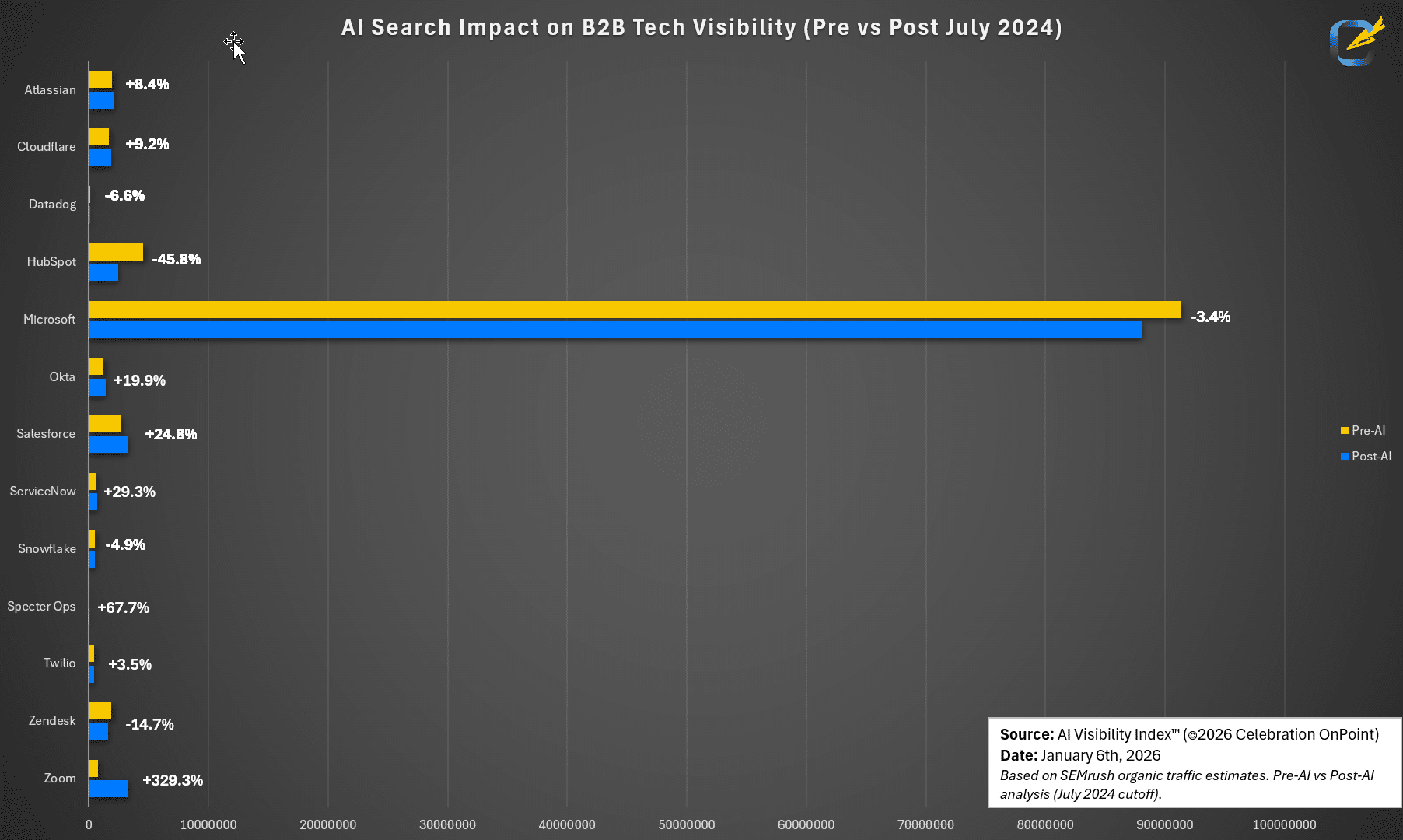
What the chart shows:
- Strong gains for platform and brand-centric companies
- Sharp declines for companies whose growth depended on non-branded, SEO-led inbound engines.
Why this is happening:
- AI still routes users to official vendors for pricing, docs, integrations
- Brand queries and product intent protect visibility—for now
🔍Strategic Insight:
This is not immunity.
It is a grace period.
B2B tech is benefiting because AI still needs a source of truth.
However, that won’t last for undifferentiated content.
Who should worry now:
- SaaS companies whose growth relies on non-branded, top-funnel SEO
- Content programs optimized for volume, not authority
3. Healthcare Organizations: Institutional Protection Holds
Key Finding:
Healthcare organizations largely maintain or improve visibility post-AI. WE look at health providers, payors, research institutions, and brands like CVS Health.
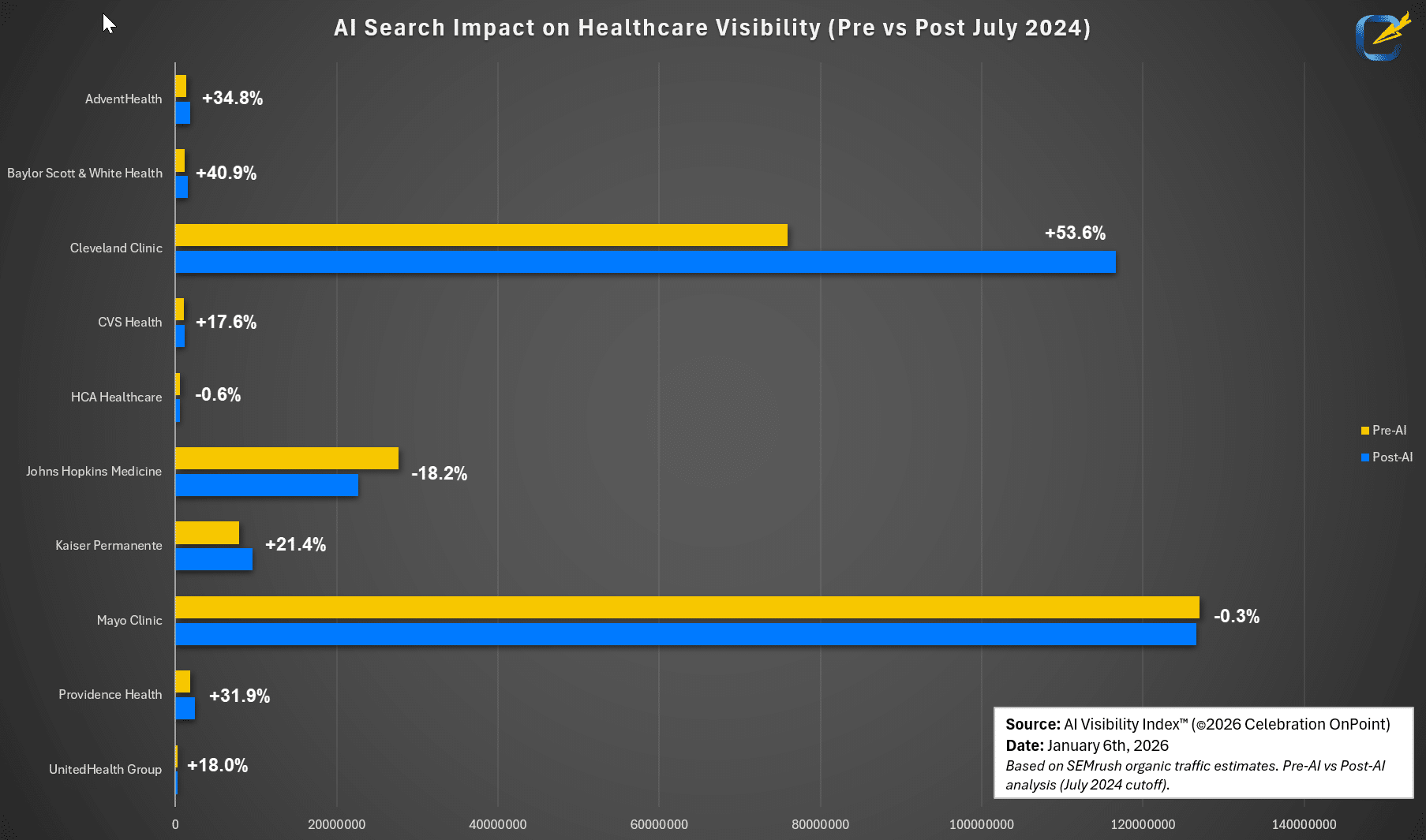
What the chart shows:
Most systems remain flat to positive, with only isolated declines.
Why this is happening:
- Regulated information
- High trust thresholds
- AI defers to established medical institutions
🔍Strategic Insight:
AI is conservative where human risk is high. This likely applies to finserve as well, but we will explore this in future expansion of the study.
In healthcare, AI behaves as a routing layer—not a replacement.
Hidden risk:
Organizations that outsource thought leadership or rely on generic health content may still be vulnerable long-term. Does your health organization reply on curated content from other sources, or are you generating original insights? As health moves more toward agentic AI solutions, are companies training models to their demise, or will they protect their intellectual property?
4. GovCon / Public Sector: Defensive Authority Wins
Key Finding:
Public sector entities and contractors show modest but stable visibility gains.
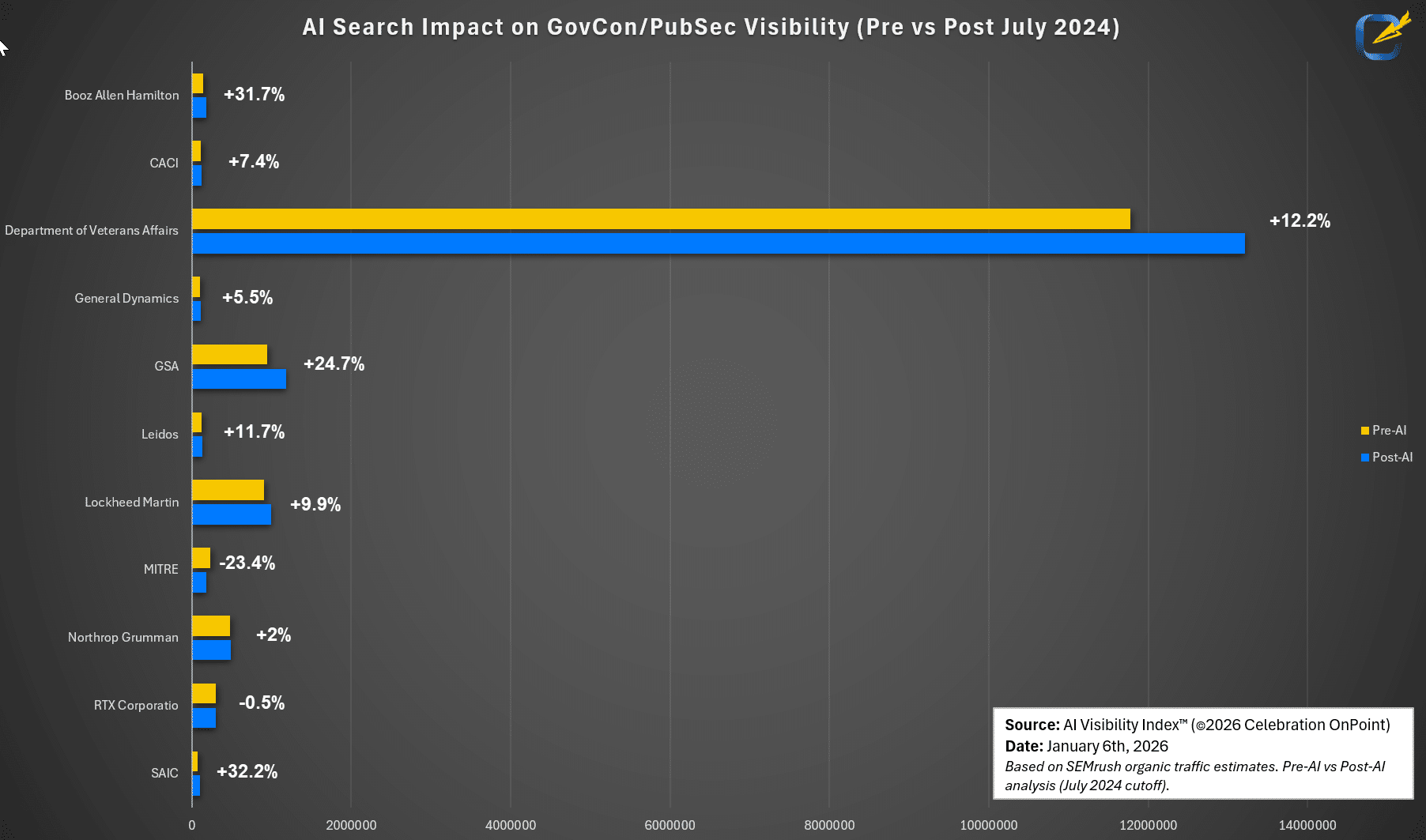
What the chart shows:
Flat to positive movement across government agencies and primes.
Why this is happening:
- Official guidance in this industry cannot be reinterpreted casually, and may be protected
- AI prioritizes primary, authoritative sources
Strategic Insight:
Visibility here is not growth marketing—it’s trust maintenance. Both agencies and government contractors need to be a source of firsthand reliable information.
AI does not disrupt authority it cannot replace.
Emerging challenge:
Talent attraction, public understanding, and influence may still shift as AI intermediates how citizens discover information.
5. Tribal Casino & Resort Gaming: The Surprise Winner
Key Finding:
As a Native American led company, we wanted to look toward Indian country for business insights. What we discovered in looking at Tribal casino and resort brands showed an outsized visibility growth, far exceeding other sectors. While we limited this to tribal casinos and resorts, future study will explore the industry more broadly.
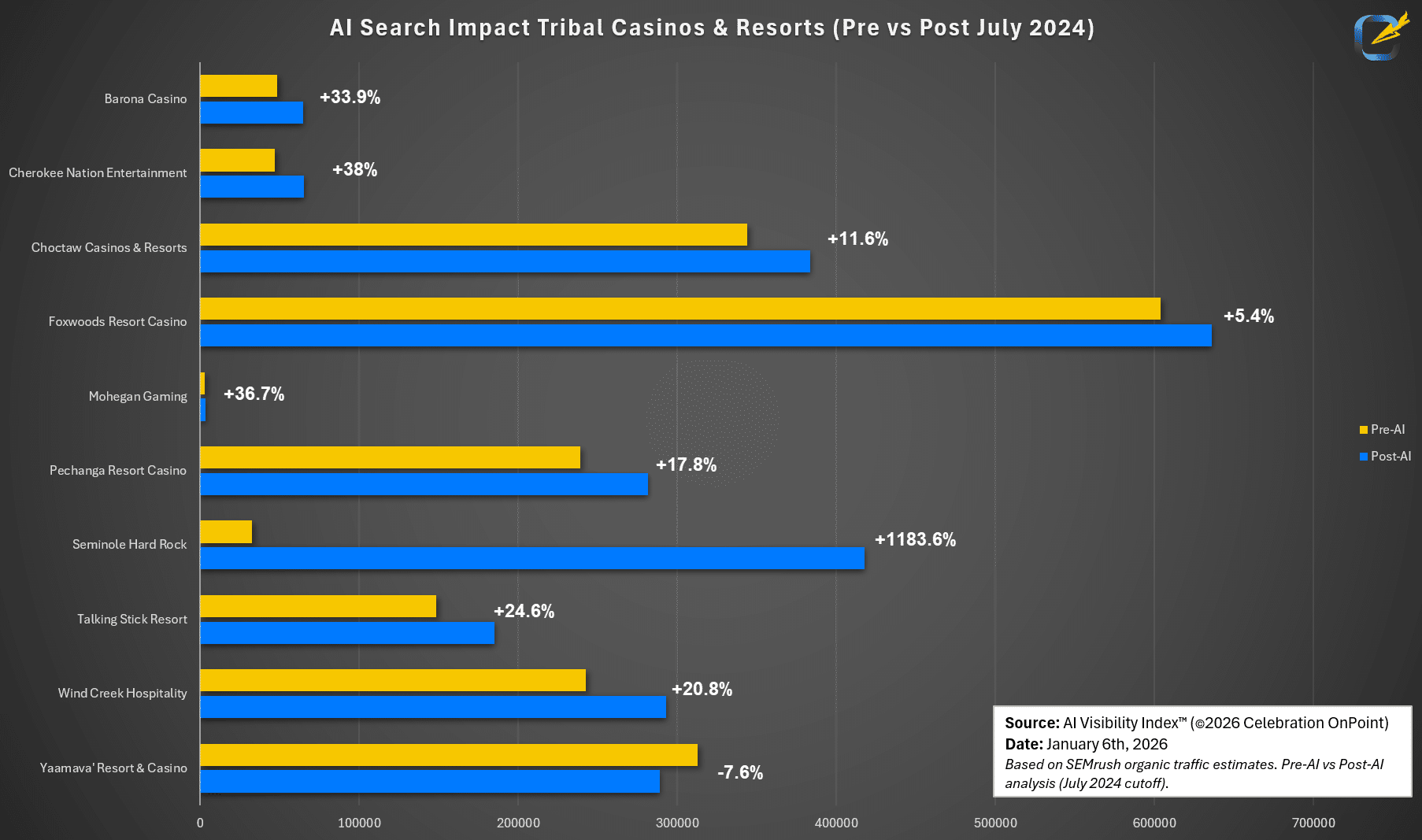
What the chart shows:
Large post-AI increases across most destinations.
Why this is happening:
- Users are searching for destination intent (“where to go,” not “what to know”)
- Strong brand + local signals drive visibility
- AI acts like a travel concierge, not an answer engine
🔍Strategic Insight:
This sector reveals a critical pattern:
When intent is experiential, AI funnels traffic instead of replacing it.
Why this matters beyond gaming:
This model applies to:
- Tourism
- Education campuses
- Hospitals
- Event-driven brands
If your value is the experience, like driving race cars, ziplining, scuba diving in a unique location – AI wants to understand the unique value. Make your experiences stand out from your competition with elements they cannot replicate. I believe this will spur on unique brand associations and loyalty programs that haven’t been created yet.
The Cross-Industry Pattern
Across all sectors, one rule holds:**AI rewards authority it must reference and removes visibility from content it can abstract.**
When you strip away industry labels, the pattern becomes even clearer:
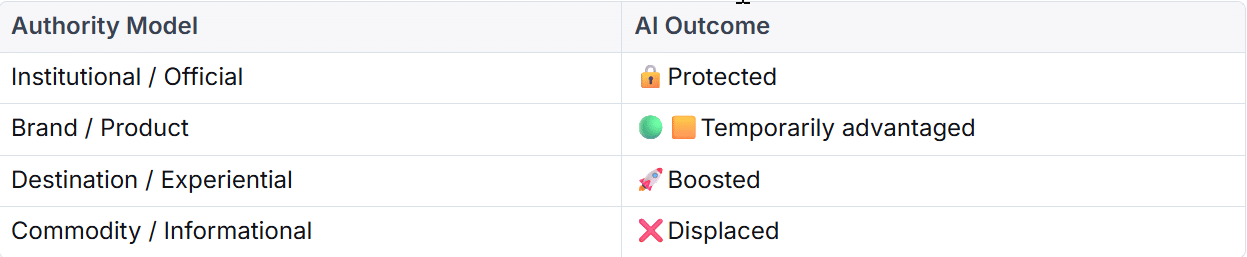
This is not an SEO problem.
It is a positioning problem.
The implication is unavoidable: visibility in the AI era is earned upstream of traffic—through authority, inclusion, and influence—not optimization tricks.
What Leaders Should Do Next
You don't need more content.
You need content AI cannot safely paraphrase without you.
That means:
- First-hand experience
- Proprietary insight
- Named frameworks
- Decision-level thinking
- Clear ownership of ideas
The question is no longer:
“Can we rank?”
The real question is:
“If AI answers this question, does it need to cite us?”
✅Action:
Audit how much of your demand relies on third-party discovery vs. direct authority.
AI didn't break search.
It revealed which business models were borrowing attention instead of owning authority.
Publishers felt it first.
Others are next.
The winners will be those who stop asking how to be found—and start ensuring they cannot be omitted.
The Gartner Prediction: A 50% Traffic Decline by 2028
Gartner’s future predictions for marketing are shocking. They forecast that traffic and content will shift to other sources. And the timeline is fast. They estimate that by 2027, 85% of customer data will be generated from automated interactions or those led by AI agents.
In 2026, the decline in AI-related search traffic is driven by the maturation of zero-click search and AI-generated summaries at the top of search results, which significantly reduces traditional search traffic to publisher websites.
This isn't hype. It's math. Backed by research.
The Forecast That's Reshaping Digital Strategy
AI answers compress:
- Research time
- Vendor comparison
- Exploration phases
Gone are the days where you have people doing vendor reviews and comparisons when AI can generate them in seconds.
Industry Studies Corroborate the Timeline
Traffic loss ≠ demand loss.
It means demand is being intercepted upstream.
✅Action:
Shift KPIs from visits to inclusion, citation, and influence.
The AI Search Landscape: Market Share and Adoption Patterns
What's breaking most visibility strategies right now isn't just AI. It's fragmentation.
For the first time in two decades, search is no longer centralized around a single dominant interface. Large language models like ChatGPT and Perplexity are transforming search by providing generative AI summaries, offering users alternatives to traditional search engines for research, news, weather, and shopping inquiries. Instead of one funnel (Google driving to a website), buyers now encounter multiple answer layers, each with different incentives, ranking logic, and citation behavior.
Google has also introduced an experimental ‘ai mode', which integrates AI Overviews with an AI chat experience, allowing users to receive summarized search results and ask follow-up questions to explore topics in greater depth. Additionally, regular updates to Google's ranking systems can cause significant fluctuations in traffic, regardless of AI features.
That changes everything about how visibility is earned.
Google's Eroding Dominance
Google is still massive. It still controls the largest share of search volume.
But it's no longer exclusive.
AI Overviews fundamentally changed the contract Google had with publishers and businesses. Instead of acting primarily as a referral engine, Google increasingly acts as an answer broker—deciding what information is sufficient without sending the click.
Google users are now increasingly interacting with AI summaries, and as they become more comfortable with AI chats, they may rely less on traditional search engines for answers, potentially decreasing organic and referral traffic.
For organizations that built their growth on predictable Google referral traffic, this shift alone is destabilizing.
The ChatGPT Phenomenon
ChatGPT flipped the model entirely.
Here, the experience isn't search results first—it's answers first.
There are no ads in the traditional sense. No blue links competing for attention. The system prioritizes:
- Clarity
- Authority
- Safety
- Defensibility
In this environment, ranking is irrelevant.
Only inclusion matters.
If the model doesn't trust you enough to cite or paraphrase safely, you simply don't exist in the response.
Perplexity's Meteoric Rise
Perplexity exposed something most SEO teams weren't ready for:
Citations matter more than backlinks.
Perplexity's growth signaled demand for transparent, sourced answers—and rewarded brands that could be cited cleanly and confidently.
In practice, this favors:
- Primary sources
- Clearly attributed analysis
- Brands with stable definitions and POVs
It punishes:
- Content farms
- SEO-first explainers
- Aggregated summaries with no ownership
Google Gemini's Strategic Advance
Gemini doesn’t feel disruptive because it's embedded.
It shows up inside:
- Search
- Workspace
- Android
- Assistant experiences
That makes it more dangerous, not less.
Gemini doesn't announce itself as a new destination. It quietly reshapes how information is surfaced inside tools people already use every day. This is ambient AI, not destination AI.
Visibility here is subtle—and easy to lose without noticing.
Traditional Search Remains Dominant—For Now
Classic search hasn't disappeared.
But it's no longer the primary battlefield.
The real competition has moved upstream:
- Into summaries
- Into comparisons
- Into AI-generated context before users evaluate options
This is why many organizations still see “okay” traffic while pipeline quality quietly degrades.
By the time traffic metrics catch up, influence has already shifted.
✅Action:
Treat AI platforms as distribution channels, not competitors.
Market Fragmentation and Regional Dynamics
One more complication leaders underestimate:
AI answers are not consistent across regions, devices, or user profiles.
The same query can produce:
- Different sources
- Different brand mentions
- Different recommendations
This fragmentation makes traditional rank tracking and impression metrics increasingly unreliable. Visibility is now probabilistic, not deterministic.
Which means authority—not optimization—is the only durable advantage.
Why This Shift Is Happening (The Forces You Can't Ignore)
The disruption we’re seeing isn't coming from a single platform or product. It's the convergence of technology capability, user behavior, and economic incentives—all moving in the same direction.
As AI-driven features like AI Overviews reshape the traditional search results page, search engine optimization is evolving from a focus on keywords to creating valuable, conversational content and maintaining strong technical SEO foundations.
Once you see these forces together, it becomes obvious why this shift isn't reversible.
As AI systems increasingly synthesize answers directly on the search results page, reducing click-through rates, it's important to implement structured data using schema markup to explicitly communicate the meaning and context of your content to search engines and AI systems.
AI Has Crossed the Capability Threshold
Search engines no longer just match keywords.
They understand intent.
Modern AI systems can:
- Decompose complex questions
- Evaluate context and constraints
- Synthesize answers from multiple sources
- Decide when a citation is necessary—and when it isn't
That changes the role of content entirely.
When AI can confidently answer a question without ambiguity, it no longer needs to send users to ten links “just in case.” It selects what it believes is sufficient.
This is not a UX tweak.
It's a fundamental change in how information is mediated.
User Behavior and Expectations Have Evolved
The technology shift worked because users were ready for it.
People don't want ten links anymore.
They want clarity.
AI answers:
- Make decision making easier
- Shorten research time
- Eliminate unnecessary exploration
Once users experience this, they don't want to go back.
Search behavior didn't change because AI forced it to.
It changed because AI matched how people already wanted to behave.
Economic Incentives Favor AI Answers
There's also a hard economic reality at play.
AI-driven answers mean:
- Fewer clicks to monetize
- Lower infrastructure costs
- Higher engagement per session
For platforms, this is rational optimization.
For businesses that relied on referral traffic, it's destabilizing—but it's not accidental. The incentives are aligned toward keeping users inside the answer layer, not sending them downstream.
Search Has Been Moving Here for Years
This didn't start with generative AI.
It's been a progression:
Links became Featured Snippets then AI Answers
Each step reduced the need for a click.
AI simply completed the trajectory.
What changed in 2024 wasn't the direction—it was the speed and confidence of the answers.
Commodity Content Reaches the Endgame
Here's the unavoidable conclusion:
If your content can be rewritten by AI without losing meaning…
it will be.
Not because it's bad.
Because it's replaceable.
Content that survives this shift shares one thing in common:
- It contains judgment
- It reflects lived experience
- It exposes tradeoffs and consequences
- It owns a point of view
That kind of content can't be safely compressed without attribution.
What This Means in Practice
You're no longer optimizing for algorithms.
You're optimizing for answer confidence.
✅Action:
Create content AI can't fake:
- Experience
- Judgment
- Tradeoffs
- Consequences
Because in the AI era, visibility doesn't go to the most optimized content.
It goes to the content that's hardest to omit.
Strategic Imperatives: How to Adapt and Thrive
Once you accept that AI search is redistributing visibility—not destroying it—the strategic implications become clear.
This is no longer a problem you solve with better keywords, more content, or another SEO tool.
It's a positioning problem.
The organizations holding ground in AI search aren't doing anything exotic. They share three traits:
- They are recognized authorities in their category
- They are consistently included when AI answers questions
- They shape how decisions are framed before buyers evaluate options, often by anticipating follow up questions and encouraging users to dive deeper through conversational content.
In other words, they've already moved upstream—from traffic optimization to decision influence.
This doesn’t require abandoning SEO fundamentals. Speed, crawlability, and technical hygiene still matter. But they are no longer sufficient. They are table stakes. To further improve visibility, target long-tail, natural language questions that users ask AI chatbots and voice assistants, and use extensive Schema.org markup to help AI systems understand your content's context.
The real strategic shift is this:
Visibility is earned before the click—inside the answer itself.
If your strategy still assumes the website is the primary battleground, you're optimizing too late in the process. AI has already influenced the decision by the time a user arrives.
The leaders who adapt fastest don't ask, “How do we get more traffic?”They ask, “Where does AI need to rely on us?”
That question reframes everything that follows.
Measuring What Matters In the AI Era
Here’s the uncomfortable truth most dashboards won't show you yet:
Losing low-intent, “just browsing” traffic often reveals how much of your past success was built on vanity metrics.
As AI handles basic questions, the people who still click through tend to want:
- Nuance
- Depth
- Judgment
- A real decision
That makes them better prospects—especially in B2B software, high-ticket services, complex financial products, and healthcare specialties—where AI summaries are only the starting point.
This is why many leaders feel a disconnect: Traffic looks “okay”… but pipeline quality feels off.
Traditional metrics were designed for a world where visibility and influence happened after the click. AI flips that order.
In the AI era, the most important signals move upstream:
- Citation Share — Are you referenced when AI answers questions in your category?
- Inclusion Frequency — Do you consistently appear across related prompts and sessions?
- Conversational Brand Endurance — Does your brand persist as the dialogue evolves?
To improve your visibility in AI-driven search, it's essential to focus on answer engine optimization (also known as AEO or Generative Engine Optimization). This specialized approach helps ensure your content is selected and cited by AI-powered answer engines and chatbots.
Additionally, use clear headings, short paragraphs, bullet points, and an FAQ format to make it easier for AI models to extract and cite your information.
These metrics don't show up neatly in Google Analytics. But they determine whether your organization is shaping decisions—or reacting to them.
Qualifying AI Referral Traffic
Yes, overall traffic will likely decline.
That's not the problem.
The real question is who still arrives.
AI-driven referrals tend to be:
- Lower volume
- Higher intent
- Closer to decision
This is why teams that obsess over session counts often miss what's actually happening. AI isn't eliminating demand. It's filtering it.
The shift in metrics is simple—but profound:
- Traffic drops
- Trust increases
✅Action:
Stop optimizing dashboards.
Start optimizing influence.
Because in an AI-mediated world, influence is the leading indicator. Revenue is the lagging one.
The Road Ahead: Predictions and Preparation
The future is not evenly distributed.
Fewer websites will win—and its important to understand that now, not later.
What compounds in the AI era isn't volume. It's authority.
- Authority compounds
- Brands become answers
- Trusted sources replace interchangeable content
As AI and answer engines reshape the landscape, engine optimization strategies must evolve. Traditional SEO remains relevant, but adapting to new paradigms like Generative Engine Optimization (GEO) and Answer Engine Optimization (AEO) is essential for visibility in a zero-click, AI-centric search environment.
Those who adapt early own the conversation. Those who don't will wonder what happened.
Enough diagnosis. Here's the strategic direction forward.
Your response should center on four pillars:
- Own your audience. Email, community, direct relationships
- Build content AI can't easily compress — proprietary data, original research, expert opinion
- Optimize for answer engines, not just SERPs
- Diversify acquisition beyond Google
To further future-proof your strategy, reduce reliance on organic search by strengthening alternative traffic sources such as email marketing and social media communities.
This isn't about tweaking title tags. It's about rewriting your acquisition strategy for a world where search engines increasingly hoard attention instead of distributing it.
Pick one or two moves per quarter. Sustainable change beats ambitious failure.

A diverse team of professionals is gathered around a whiteboard, actively discussing and planning their digital marketing strategy, focusing on optimizing search engine results and enhancing brand visibility in the evolving AI era. They are likely exploring topics such as SEO, AI-driven search, and the impact of generative AI on organic traffic and user engagement.
Pillar 1: Own Your Audience, Don't Rent It
In a world where AI sits between you and the user, direct relationships become your strongest moat.
Email lists, newsletters, and private communities aren't “old school.”
They're insulation.
If visibility becomes volatile, ownership becomes priceless.
Pillar 2: Create Content AI Can't Easily Steal
AI is exceptional at recombining what already exists.
It struggles with:
- Proprietary data
- Strong point of view
- Real experience
- Specific numbers and consequences
That's your advantage.
If your content could be written by someone who's never done the work…
it's already at risk.
Ask of each new article: “What here would force AI to reference me instead of my competitors?”
Pillar 3: Optimize For Answer Engines (Not Just Blue Links)
Answer engines reward clarity, structure, and defensibility.
To achieve visibility in AI-driven search, answer engine optimization—also known as Generative Engine Optimization (GEO) or AEO—has become a key strategy. In 2026, adapting your approach from traditional SEO to Generative Engine Optimization (GEO) will be essential to become the cited source within AI responses.
They don't reward clever hacks.
The goal isn't to game AI. It's to become the clearest, safest source for the answers that matter in your category.
Pillar 4: Diversify Beyond Google
Google is still important.
It's just no longer the sun everything orbits around.
Authority now travels across:
- Communities
- Video
- Podcasts
- Partnerships
- Direct relationships
Visibility is a portfolio problem now—not a single-channel bet.
Conclusion: The Best Is Yet to Come
If your growth depends on being found, it's time to become unavoidable.
AI didn't kill search.
AI didn't kill your leads.
It revealed whether you ever truly owned your distribution.
This isn't the end of traffic.
It's the end of lazy visibility.
That's why publishers felt the shift first.
Their product was attention.
Others look “fine” today—but don't confuse temporary protection with immunity.
AI doesn't punish everyone equally.
It punishes what it can summarize without attribution.
So the question every revenue leader must answer is no longer:
“How do we get more traffic?”
I'ts this:
“If AI answers the core questions in our market tomorrow… does it need to mention us?”
If the answer is no, you're late.
Part Two is where we operationalize everything you've just read.
It's called Authority → Inclusion → Influence: The 30-Day Operating System, and it breaks down the exact system we use to help organizations earn AI citations, protect discoverability, and influence decisions before the click—without publishing more noise.
If this article explained why visibility is shifting, Part Two shows you how to respond in the next 30 days.
👉 Read Part Two: AI-Ready Visibility: The 30-Day Operating System
FAQ's
This is not a normal algorithm update.
Algorithm updates change how you rank.
AI search changes whether a click is necessary at all.
When AI answers questions directly—often without sending traffic—the entire discovery model shifts. What we’re seeing now is a structural redistribution of visibility, not a temporary ranking fluctuation you can wait out.
Yes—but traffic is no longer the starting point.
In the AI era:
- Influence happens before the click
- Decisions are shaped inside the answer
- Traffic becomes a lagging indicator, not a leading one
The real risk isn’t losing traffic.
It’s losing inclusion in the answers that shape buyer intent.
Because AI does not treat all content equally.
AI rewards sources it must:
- Defer to (healthcare, government)
- Route to (destinations, experiences)
- Reference by name (strong brands, platforms)
It removes visibility from content that can be summarized without attribution.
That’s why publishers are hit first—and why B2B tech currently sits in a temporary advantage window.
No. But SEO alone is no longer sufficient.
Traditional SEO optimized for:
- Crawlers
- Keywords
- Rankings
AI search optimizes for:
- Authority
- Answer confidence
- Defensibility
The shift isn’t from SEO to “no SEO.”
It’s from SEO to SEO + Generative Engine Optimization (GEO).
Inclusion means:
- Your brand is cited or named
- Your definitions or frameworks shape the response
- Your language is reused across answers
You can be:
- Highly ranked
- Frequently scraped
- Technically “visible”
…and still be absent from the AI response.
That’s the most dangerous failure mode: being useful but invisible.
Look for these early warning signs:
- Organic traffic flattening while impressions stay high
- Pipeline quality degrading before volume drops
- Prospects arriving with pre-formed opinions you didn’t create
- Your brand appearing less frequently in AI tools like ChatGPT or Perplexity
If any of those are happening, AI is already shaping demand upstream.
Content that survives has one thing in common:
it’s hard to paraphrase without attribution.
That includes:
- Proprietary data and original research
- First-hand experience and judgment
- Clear tradeoffs and consequences
- Named frameworks and decision models
If your content could be written by someone who’s never done the work, AI will eventually replace it.
Marketing teams think in terms of:
- Traffic
- Rankings
- Campaigns
Revenue leaders need to think in terms of:
- Control vs dependency
- Inclusion vs invisibility
- Influence before pipeline
AI search is not a channel problem.
It’s a revenue architecture problem.
Creating more content.
Volume made sense when clicks were guaranteed.
In the AI era, more content often creates more noise.
The winning move is not publishing more—it’s publishing content AI cannot safely omit.
This shift is permanent.
The tools may evolve, but user behavior won’t reverse.
Once people get clear, immediate answers, they don’t go back to ten blue links.
The only sustainable response is to become a source AI depends on, not a page it occasionally visits.
Start by answering one question honestly:
"If AI answers the core questions in our market tomorrow, does it need to mention us?"
If the answer is unclear or no, that’s your starting point.
From there, the work is about:
- Authority
- Inclusion
- Influence
Traffic follows later.
